Christmas Math Game Multiplication 0-12: A Practical Review
The holiday season in an educational setting often presents a unique challenge for educators and parents. The natural shift toward festive activities can disrupt the rhythm of academic instruction, particularly in foundational subjects like mathematics. However, maintaining fact fluency during December is critical for student success in the coming year. This is where resources like the Christmas Math Game Multiplication 0-12 become relevant. Rather than serving as a mere distraction, this tool represents a strategic approach to integrating seasonal engagement with rigorous math practice. For professionals managing classrooms, homeschooling environments, or small group tutoring sessions, evaluating whether such a resource offers genuine pedagogical value is essential before allocating time and materials.
Core Functionality and Design Philosophy
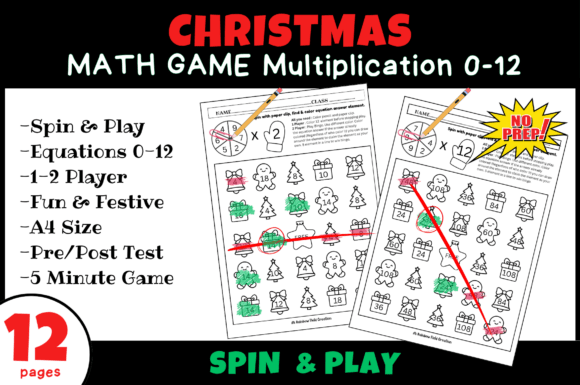
At its heart, the Christmas Math Game Multiplication Equations 0–12 is designed to address a specific learning objective: mastering multiplication facts from zero through twelve. The design philosophy prioritizes "NO PREP" usability, which is a significant factor for busy educators who need reliable materials without extensive setup time. The resource typically includes pre-formatted equation cards, game instructions, and thematic elements that require only printing and cutting. This streamlined workflow allows teachers to transition quickly into instructional time, maximizing the utility of short periods like early finisher slots or morning warm-ups.
The inclusion of a festive theme serves a dual purpose. Visually, it captures the attention of students aged roughly 7 to 10 (2nd–4th grade), making the repetitive nature of fact drilling more palatable. Psychologically, it leverages the excitement of the holidays to lower anxiety around testing or rote memorization. When students perceive an activity as a game rather than a drill, their cognitive load shifts from performance anxiety to engagement, potentially improving retention rates. The Christmas Math Game Multiplication 0-12 capitalizes on this by embedding standard mathematical equations within a cheerful holiday context, ensuring the content remains consistent with curriculum standards while the delivery method aligns with the seasonal mood.
Educational Value and Skill Reinforcement
From a pedagogical standpoint, the primary strength of this resource lies in its focus on fact fluency. Multiplication mastery is a gateway skill for higher-level mathematics, including division, fractions, and algebra. Without automatic recall of these facts, students struggle with complex problem-solving later in their education. The Christmas Math Game Multiplication Equations 0–12 provides the necessary repetition to build this automaticity. Unlike passive worksheets, the game format encourages active participation. Whether played in pairs or individually, students must process the equation, retrieve the answer from memory, and verify it, creating a stronger neural pathway than simple copying.
The scope of the content, covering facts from 0 to 12, ensures comprehensive coverage of the standard multiplication table. This breadth is crucial because gaps in knowledge—such as struggling specifically with the 6s or 9s—can hinder overall progress. By randomizing the presentation of these facts through game mechanics, the resource prevents pattern recognition shortcuts and forces genuine recall. For educators tracking student progress, this type of targeted practice is invaluable. It allows for focused intervention on specific number sets if a student demonstrates difficulty, all while maintaining the integrity of the full curriculum.
Usability in Diverse Learning Environments
The versatility of the Christmas Math Game Multiplication 0-12 extends beyond traditional classroom settings. Its modular design makes it suitable for various educational contexts:
- Math Centers: In a station-based rotation model, this game functions effectively as a self-contained activity. Students can work independently or with partners, requiring minimal teacher supervision once the rules are understood.
- Small Group Instruction: Teachers can use the cards for guided practice, observing student strategies and providing immediate feedback. The tactile nature of handling cards aids kinesthetic learners.
- Homeschooling: For parents managing multiple children or subjects, the "print and play" aspect reduces preparation stress. It offers a structured yet fun way to incorporate math into daily routines during the holiday break.
- Early Finishers: One of the most practical applications is for students who complete assignments ahead of schedule. Having a meaningful, curriculum-aligned activity prevents downtime and keeps students engaged in productive learning.
Practical Considerations and Limitations
While the Christmas Math Game Multiplication Equations 0–12 offers clear benefits, a balanced evaluation requires acknowledging its limitations. The reliance on physical printing means there is an upfront cost for paper and ink, and durability depends on whether the materials are laminated. Without lamination, the cards may wear out quickly in high-traffic centers, necessitating reprinting. Additionally, the game is inherently tied to the holiday season. While this is a feature for December use, it limits the resource's longevity compared to neutral-themed materials. Educators should consider this when planning long-term budgets and resource libraries.
Another consideration is the level of scaffolding provided. While excellent for reinforcement, the game assumes students have been introduced to the concept of multiplication. It is not a direct instruction tool for teaching the concept for the first time. Therefore, it fits best as a review or practice mechanism rather than an introductory lesson. Teachers must ensure that students possess the prerequisite knowledge before deploying the game to avoid frustration.
Quality and Consistency
In terms of production quality, digital resources of this nature vary based on the creator. High-quality versions will feature clear typography, logical grouping of numbers, and durable file formats. The Christmas Math Game Multiplication 0-12 described here emphasizes clarity and ease of use, which are markers of a well-designed educational asset. The inclusion of easy-to-follow instructions is a critical component; ambiguous rules can derail a lesson plan and waste valuable instructional time. A resource that anticipates user needs by providing clear guidance demonstrates professional foresight and enhances the overall user experience.
Furthermore, the restriction on commercial use is a standard and necessary clause for intellectual property protection. It ensures that the creator maintains control over their work while allowing broad access for personal and classroom use. This balance supports the ecosystem of educational content creation, encouraging developers to produce high-quality tools like this one.
Strategic Implementation Recommendations
To maximize the effectiveness of the Christmas Math Game Multiplication Equations 0–12, educators should integrate it thoughtfully into their broader instructional strategy. It should not replace direct instruction but rather complement it. For instance, after a week of focusing on the 7s and 8s, the game can serve as a cumulative review. Teachers might also differentiate the activity by allowing advanced students to race against a timer or pairing them with peers who need additional support, fostering peer-to-peer learning.
For those considering this resource for their workflow, the decision ultimately hinges on the need for engaging, low-prep practice materials during the holiday season. If the goal is to maintain momentum in math skills without sacrificing the festive spirit, this tool offers a pragmatic solution. It bridges the gap between academic rigor and student enjoyment, proving that learning does not have to pause for the holidays. By selecting resources that align with both curriculum goals and student interests, educators can ensure that December remains a month of growth rather than stagnation.